

Friday, December 18, 2009
Life
Miranda doesn't have liquid water. But it does have ice water because of with the low density body likely containing silicate rock and organic compounds in its interior. Miranda has no detectable atmosphere and no magnetic field. Miranda doesn't have an oxygen atmospthere, it is near Uranus and it is also a moon. I personally don't think that there is is life on Miranda. Uranus is the 7th planet from the sun, and Miranda is a moon of it, so there is probally not.

Europa is a moon of Jupiter. Jupiter is the 5th planet from the sun. Scientists think there is life on Europa. Since there is liquid water underneath the ice water, there might be life on Europa. I think there might be too. Since water formed humans, and humans need water to survive, then there might as well be life on Europa.

Monday, December 14, 2009
Space Travel
Astronomical Unit (AU), Kilometers (Km) and Light years (Ly) are 3 differnt ways that you can measure space travel. AU is the distance between the sun and the earth. Kilometers measures the distance between each planet.
How long it would take to get to Uranus from Earth would depend on the path chosen and on where Uranus and Earth were in their orbits when the mission was launched. For example, the Voyager 2 spacecraft was launched on Aug 20, 1977 and it reached Uranus on Jan 24 1986. So, Voyager 2 took almost nine and a half years to reach Uranus.
I think that people can land on Uranus, but who ever wants to, they can spend 9 years in a space shuttle, just to prove that man CAN walk on Uranus.
Monday, November 23, 2009
Miranda Formation

First a supernova explosion occurs, hot gas and dust from around the supernova and swirl around in space. As the nebula cools atoms move slower and clump together. Accretion begins, ssmall objects in space collide, making large bodies in space. Miranda was hit by a comet or asteroid. Taken over by Uranus's gravational pull, Miranda now orbits Uranus and is considered a moon.
Thursday, November 19, 2009
More about Miranda
Voyager 2 was the spacecraft the discovered Miranda. Voyager 2 was forced to fly close to Uranus in order to get the boost it needed to go on to Neptune and due to the orientation of the whole system at almost right angles to the ecliptic only Miranda was approached closely. Before Voyager, of course, little was known about Miranda and as it is not the largest or in any other way remarkable, it probably would not have been chosen as the prime target at Uranus. Voyager's good luck held up, however, as Miranda turned out to be by far the most interesting. It was initially thought that Miranda had been completely shattered and reassembled several times in its history, each time burying some parts of the original surface and exposing some of the interior. Now, however, a more mundane explanation involving the upwelling of partially melted ices seems to be in favor. This is the spacecraft, Voyager 2
 This is the spacecraft, Voyager 2
Monday, November 9, 2009
Planet?
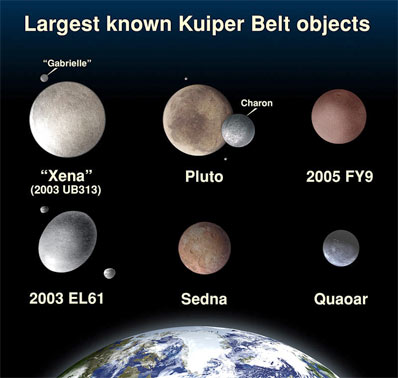
Today we were told why Pluto is no longer a planet. For Pluto to be a planet, it has to, 1. orbit a star. 2. have enough gravitational pull to control objects in its neighborhood meaning that it has a clear orbit, 3. it has to be spherical. Pluto orbits the sun, which is a star. so maybe it is a planet. Pluto has enough gravitational pull to be in a spherical shape. But Pluto does not have a "clear neighborhood" of it's orbit. So it is not a planet.
My body, Miranda a moon of Uranus, is not a planet. My body doesn't orbit a star, or have a gravitational pull that it is spherical.

INTRESTING FACT: Gerald Kuiper who discovered Miranda. The Kuiper Belt was named after him.
My body, Miranda a moon of Uranus, is not a planet. My body doesn't orbit a star, or have a gravitational pull that it is spherical.
Wednesday, November 4, 2009
Miranda V.S. Sun

Wednesday, October 28, 2009
Museum Trip
On October 26, my class and I went to the Museum of Natural History. When we were there we went to the Hall of Meteorites, the Rose Center and saw Journey to the Stars. In the Hall of Meteorites, we walked around and had to find what a meteor and a meteorite were. We had to find what was different between them. In the Rose Center we went to go see the Big Bang. The Big Bang was a movie about how the universe started. After that we walked down the Cosmic Pathway, and went to see Journey to the Stars. Journey to the Stars was about what stars are, the sun and then sun today. We were told that eventually the sun will stop providing us heat, but when it does, humans will be long gone.
I learned that 4 billion years ago land was first formed on earth. Meteorites collide on earth, they leave craters of many sizes which provide us hot earth was formed. Chrondules are spheres found in meteorites. They tell us the formation of our vast solar system.
I want to know why astronomers cared about finding new planets and moons. Why they wanted to find out how they universe started.
Tuesday, October 20, 2009
Miranda: A Big Mystery
 Miranda was discovered by Gerard Kuiper Feburay 16, 1948. Gerard Kuiper named it after a character in William Shakespeare’s plays. It was discovered in telescopic photographs of the Uranian system.
Sources: http://www.solarviews.com/eng/miranda.htm
http://www.britannica.com/facts/5/12666/Gerard-Peter-Kuiper-as-discussed-in-Miranda-astronomy
Subscribe to:
Posts (Atom)

